
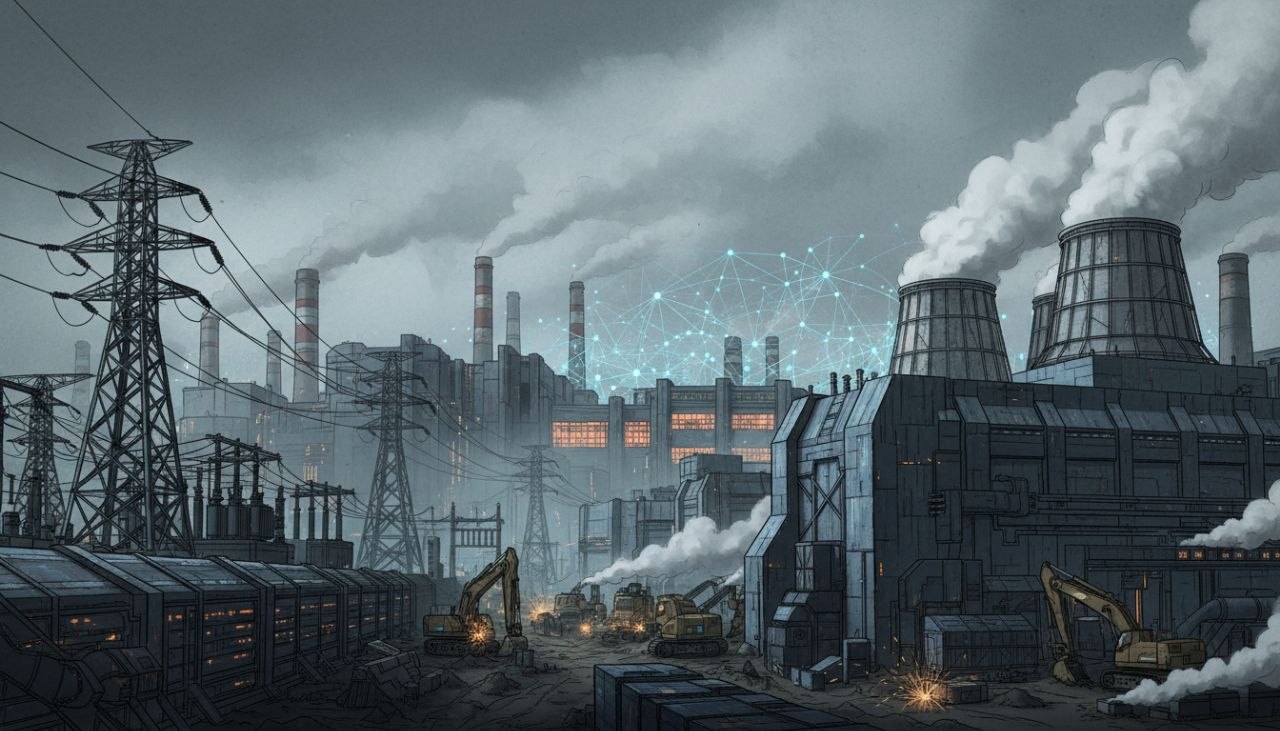
For nearly two decades, the technology industry's defining myth has been the cloud. Build once, deploy everywhere. Near-zero marginal costs. Infinite scalability at the click of a button. Venture capitalists wrote billion-dollar checks based on this promise, and for a long time, the promise held. SaaS companies achieved margins that industrial giants could only dream of. A software engineer in San Francisco could serve a million customers without ever touching a physical server.
But something fundamental is shifting beneath the surface, and the venture and technology landscape is undergoing a structural re-pricing that few investors have fully internalized yet. The assumptions of software-driven scalability — the very foundation upon which modern tech valuations rest — are being replaced by the hard constraints of physical infrastructure, energy systems, and geopolitical control points. What once appeared abstract and weightless — compute, connectivity, and deployment — is now tightly coupled to power grids, capital intensity, and state policy. AI, in other words, is not scaling like software. It is scaling like heavy industry.
The End of the SaaS Metaphor
To understand why this matters, you have to understand what made the SaaS model so intoxicating to investors. The core thesis was elegant in its simplicity. Develop a product once, then sell it repeatedly with minimal additional cost. Gross margins of 80% or higher were not just possible; they were expected. The entire venture playbook — from seed funding to IPO — was built around this expectation. Companies were valued based on their ability to grow revenue faster than their costs, and the cloud made that equation work beautifully.
AI, at first, seemed to fit this mold perfectly. Large language models were software, after all. They ran on code, not coal. You trained them on data centers, but once trained, they could serve responses to millions of users at near-zero marginal cost. The early AI startups raised money on SaaS multiples, pitched their businesses with SaaS metrics, and promised SaaS margins. Investors, trained by fifteen years of cloud success, eagerly bought in.
The problem is that AI does not actually work this way. Not at scale. Not anymore. The models that generate the most value today — the frontier models that power everything from coding assistants to scientific research — require enormous amounts of compute to train and, increasingly, enormous amounts of compute to run. Inference costs, once an afterthought, are now the dominant expense line for many AI companies. And inference is not a software problem. It is a hardware problem, an energy problem, and a logistics problem dressed up in code.
The Physics of Intelligence
Here is the uncomfortable truth that the industry is slowly waking up to: intelligence has a physical footprint. Every query you send to a large language model, every image you generate, every video you synthesize — all of it requires a specific number of floating-point operations executed on a specific number of specialized chips, drawing a specific amount of electricity, generating a specific amount of heat, in a specific building somewhere on Earth. There is no magic. There is no abstraction that eliminates this physical reality. The cloud was an abstraction layer that made compute feel weightless, but the weight never actually went away. It just got pushed down the stack, out of sight, into someone else's data center.
Now that abstraction is cracking. The largest AI companies in the world — OpenAI, Google, Anthropic, Meta, Microsoft, xAI, and their Chinese counterparts — are locked in an arms race that is fundamentally about physical infrastructure. They are not competing on software elegance or product design, though those matter at the margins. They are competing on who can build the most data centers, secure the most power contracts, and manufacture or acquire the most GPUs. This is not a software business. This is a capital-intensive, resource-constrained, physically grounded industrial competition.
Consider the numbers. Training a single frontier model today can cost between $100 million and $1 billion, depending on the scale and the ambition. That cost is almost entirely hardware and energy. The salaries of the researchers matter, but they are a rounding error compared to the compute bill. And the compute bill is not going down. If anything, it is accelerating. Each new generation of models requires roughly an order of magnitude more compute than the last. The scaling laws that have governed AI progress for the past decade show no signs of breaking, which means the infrastructure requirements will keep growing exponentially for the foreseeable future.
Infrastructure as the New Moat
In the SaaS era, a company's moat was typically its software — its user interface, its workflow integrations, its brand, its network effects. These were intangible assets that scaled beautifully and required relatively little additional capital to defend. In the heavy industry era of AI, the moat is increasingly physical. The companies that will dominate are the ones that control the infrastructure: the data centers, the power purchase agreements, the chip supply chains, the cooling systems, the real estate.
This is why Microsoft is spending $80 billion on AI infrastructure in a single year. It is not because they love construction. It is because they have done the math and realized that without physical infrastructure, they cannot participate in the next phase of AI at all. The models are too big, the inference costs too high, the latency requirements too strict for a purely cloud-native approach. They need to own the stack, from the silicon to the cooling tower, because that is where the margin lives — or rather, that is where the margin dies if you do not control it.
Google, Amazon, and Meta are making similarly enormous bets. In China, ByteDance, Alibaba, and Huawei are pouring tens of billions of dollars into domestic chip production and data center construction, driven partly by competitive pressure and partly by the recognition that reliance on foreign silicon is a strategic vulnerability. The geopolitical dimension of AI infrastructure cannot be overstated. Countries are increasingly treating compute capacity as a matter of national security, regulating exports, subsidizing domestic production, and building sovereign AI clouds. The infrastructure is no longer just a business asset. It is a political asset.
The Energy Crisis Nobody Talks About
Perhaps the most underappreciated constraint on AI's future growth is energy. A single large data center can consume as much electricity as a small city. The hyperscalers are already struggling to find enough power in desirable locations. In Northern Virginia, the heart of America's internet infrastructure, utility companies have warned that data center demand is outstripping supply. In Ireland, data centers now account for nearly 20% of national electricity consumption, prompting regulatory pushback. Singapore, one of Asia's key digital hubs, imposed a moratorium on new data centers for years because of power constraints.
The energy problem is not just about quantity. It is also about location, transmission, and timing. AI workloads are bursty and unpredictable — a viral product launch or a major model update can spike demand by orders of magnitude overnight. Traditional power grids are not designed for this kind of volatility. They are designed for steady, predictable industrial loads. The mismatch is causing real problems, and solving it requires either overbuilding capacity (expensive) or developing new energy storage and load-balancing technologies (also expensive, and still immature).
Some companies are exploring radical solutions. Microsoft has experimented with underwater data centers to reduce cooling costs. Google and others have invested heavily in renewable energy, not just for public relations reasons but because they need power that is both cheap and geographically available. There are even serious discussions about putting data centers in orbit, where solar energy is abundant and cooling is free — though the logistics of getting hardware into space and maintaining it there remain formidable.
What This Means for Investors
The transition from software-driven to infrastructure-driven AI has profound implications for how technology companies should be valued and how investment portfolios should be constructed. The SaaS playbook — high growth, high margins, capital-light — does not apply cleanly to a world where the biggest companies are spending more on concrete and copper than on code. The economics look different. The timelines look different. The risks look different.
For venture capitalists, this means a fundamental rethinking of entry prices and exit expectations. A company that requires $500 million in infrastructure investment before it can serve its first paying customer is not a venture bet in the traditional sense. It is an infrastructure bet with a technology wrapper. The returns may still be attractive, but they will be more cyclical, more capital-intensive, and more exposed to macroeconomic variables like interest rates and commodity prices. The days of seed-stage AI startups achieving billion-dollar valuations on PowerPoint presentations are fading, if not already over.
For public market investors, the rotation is already visible. The market is increasingly rewarding companies that can demonstrate a clear link between capital expenditure and revenue, and punishing those where the connection remains speculative. Nvidia's extraordinary rise is not just a bet on AI; it is a bet on the physical infrastructure that AI requires. Similarly, the renewed interest in utility companies, industrial real estate, and energy infrastructure is driven by the recognition that these sectors are now integral to the technology stack, not incidental to it.
The New Industrial Titans
If this analysis is correct — and the evidence is mounting that it is — then the companies that dominate AI in the coming decade may look very different from the ones that dominated the cloud era. They may look more like industrial conglomerates than software startups. They may have large workforces of electricians and HVAC technicians alongside their machine learning researchers. Their board meetings may spend as much time on power purchase agreements and construction timelines as on product roadmaps and user acquisition metrics.
This is not necessarily a bad thing. Heavy industry has produced some of the most durable and profitable companies in history. But it operates on different rules. The winners are determined less by viral growth loops and more by operational excellence, supply chain management, and capital efficiency. The competitive advantages are harder to replicate because they are rooted in physical assets that take years to build and billions of dollars to acquire. The barriers to entry are higher, but so are the barriers to competition once you are inside.
For the technology industry, this represents a kind of homecoming. Before the cloud, computing was physical. You bought a mainframe, installed it in a room, hired people to maintain it, and paid the electricity bill. The cloud abstracted all of that away, and the industry spent twenty years pretending that the physical layer did not matter. AI is forcing a correction. The physical layer matters enormously. It always did. We just forgot.
What to Watch Next
The next twelve to eighteen months will be critical for understanding how this transition plays out. Watch the capital expenditure numbers from the major hyperscalers — not just the totals, but the mix between software development and physical infrastructure. Watch the energy markets, particularly in regions with high data center density, for signs of strain or regulatory response. Watch the semiconductor supply chain, especially for advanced packaging and memory, which are becoming bottlenecks in their own right. And watch the emerging class of AI infrastructure startups — the companies building the tools, services, and platforms that make heavy industry feel a little bit lighter.
The cloud was a beautiful idea. It made technology feel limitless, weightless, free. But ideas have physical consequences, and the consequence of AI is that we are rebuilding the world's industrial base around the production of intelligence. The companies that understand this — that embrace the heaviness rather than fighting it — will be the ones that define the next era. The ones that do not will find themselves trying to run a steel mill with a SaaS playbook, wondering why the numbers never add up.