
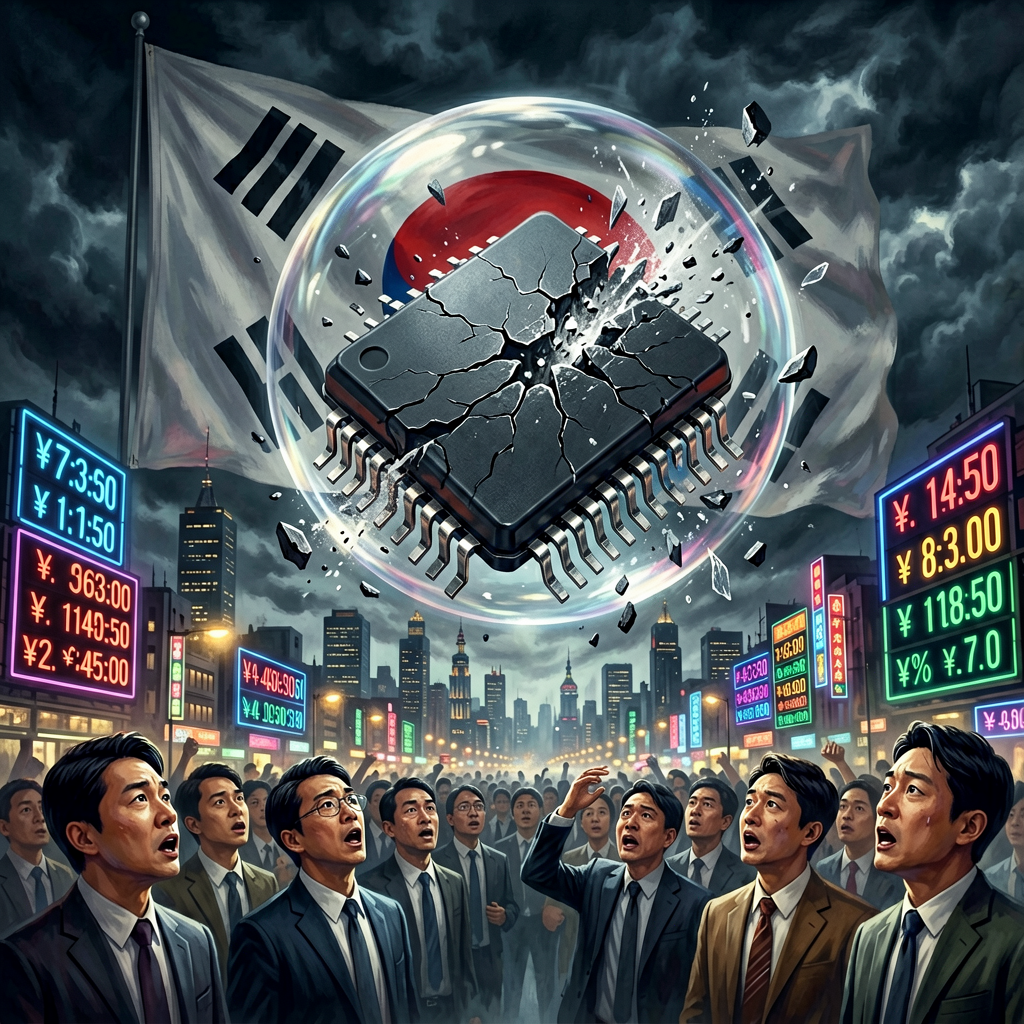
South Korea's KOSPI index crossed 8,000 last month. Let that sink in. A benchmark that took three decades to reach 4,000 just doubled in six months. Samsung and SK Hynix — two memory chip companies — now account for nearly half the entire index. And Korean retail investors, nicknamed "the ants," are pouring their life savings into leveraged ETFs through offshore platforms.
If this sounds familiar, it should. We've seen this movie before. It doesn't end well.
The Numbers That Should Terrify You
The KOSPI gained 100% in the first half of 2026. That's not a rally. That's a mania. For context, the Nasdaq's best year during the dot-com bubble was 86% in 1999. The KOSPI just beat that in six months.
And it's not broad-based. Samsung Electronics and SK Hynix together account for 40-50% of the KOSPI's total weight. That means nearly half the index's performance depends on two companies in the same industry, selling the same category of products, to the same set of customers — American and Chinese tech giants.
SK Hynix, a memory chip company in one of the most cyclical industries on Earth, briefly hit a $1 trillion market cap in May. Let that sink in. A company that makes DRAM and NAND flash — commodities that swing between shortage and glut every few years — was valued higher than Coca-Cola, Disney, and Netflix combined.
This is not rational. This is not sustainable. This is not even original.
The Ants Are Marching — Off a Cliff
South Korean retail investors, colloquially known as "the ants," have been the dominant force behind this rally. Every time foreign investors pulled back, the ants stepped in. They bought the dips. They loaded up on leveraged ETFs. They became the market's backstop.
But here's what the cheerleaders won't tell you: some of these investors are accessing leveraged exposure through ETFs and platforms based in Hong Kong. When retail traders start reaching for leverage in a market that's already doubled, the word "bubble" isn't just appropriate — it's mandatory.
Sound familiar? It should. Korean retail investors were the driving force behind the 2021-2022 crypto bubble. They piled into Luna, they aped into altcoins, they got wiped out when the music stopped. Now they've moved from crypto casinos to leveraged semiconductor ETFs. Same behavior. Same psychology. Same outcome waiting to happen.
The only difference is the scale. Crypto was a sideshow. The KOSPI is the entire Korean economy.
The Concentration Problem Nobody Wants to Talk About
Let's be clear about what the KOSPI actually is. It's not a diversified index representing South Korea's economy. It's a two-stock index with some garnish.
Samsung Electronics and SK Hynix. That's it. Two companies. One industry. If AI chip demand slows — and it will, because it always does — half the Korean stock market goes down together.
And the signs are already there. On June 9, the KOSPI posted an 8.18% single-day rebound following a prior downturn. That's not healthy volatility. That's a warning. When an index that doubled in six months starts swinging 8% in a day, it's not a bull market anymore. It's a casino.
South Korean semiconductor exports surged 53.2% year-on-year in May. Impressive, until you remember that export growth was negative 12 months ago. Memory chips are cyclical. They always have been. The boom creates the bust. The bigger the boom, the harder the bust.
The AI Chip Demand Mirage
Here's the dirty secret behind the KOSPI surge: it's not really about AI. It's about memory chip prices.
AI servers need HBM (High Bandwidth Memory). SK Hynix makes most of it. Demand is real — for now. But here's what the bulls forget: every major tech company is simultaneously building data centers, ordering chips, and stockpiling inventory. When that inventory shows up — and it will — the orders stop.
We've seen this before. In 2018, memory chip prices crashed 40% after two years of shortage-driven boom. Samsung and SK Hynix saw their profits evaporate. The KOSPI dropped 20%. And that was a normal cycle. This cycle is magnitudes larger.
The key variable to watch is AI chip order flow over the next two quarters. Any deceleration in orders from major US and Chinese tech companies would hit Korean chipmakers first and hardest, given their outsized role in the memory segment. Inventory buildup at customer sites would be an early warning signal.
But here's the problem: by the time you see inventory buildup, it's too late. The market will have already crashed.
🔥 Hot Takes
1. The KOSPI is not a stock market. It's a leveraged bet on one product cycle. When you buy the KOSPI, you're not investing in South Korea's economy. You're betting that AI companies will keep ordering memory chips at record prices indefinitely. You're betting that Chinese companies won't build their own HBM. You're betting that the memory chip cycle has been repealed by AI. None of these bets are smart.
2. Korean retail investors didn't learn from crypto. They just changed casinos. The same "ants" who got wrecked on Luna and altcoins are now buying 2x leveraged semiconductor ETFs through Hong Kong platforms. The behavior is identical: FOMO, leverage, concentration, denial. The only difference is the asset class. And when this bubble pops, the losses will be bigger because the leverage is higher and the concentration is worse.
3. SK Hynix at $1 trillion is the most absurd valuation in tech. This is a memory chip company. It makes commodities. It has no pricing power. It has no moat. Chinese competitors like YMTC are already at 13% NAND market share and climbing. In three years, SK Hynix will be fighting for margins in a glutted market. The $1 trillion valuation will look as ridiculous as Cisco's $500 billion market cap in 2000. And it will end the same way.
The Bottom Line
South Korea's chip mania is not a new paradigm. It's an old story with new characters. The 2021 crypto bubble. The 2000 dot-com bubble. The 1989 Japanese asset bubble. They all followed the same script: retail investors, leverage, concentration, and the belief that this time is different.
The KOSPI at 8,000 is not a sign of strength. It's a warning sign. When two companies control half an index, when retail investors use leverage to buy the dip in a market that's already doubled, when a memory chip company trades at $1 trillion — you're not in a bull market anymore.
You're in the final act of a bubble. And the Korean retail investors who think they're buying the future are actually buying the top.